
The Story: TAKING MATTERS INTO YOUR OWN HANDS
Episode 7 | 24m 36sVideo has Closed Captions
Discover three stories of distinct Texans who have taken matters into their own hands.
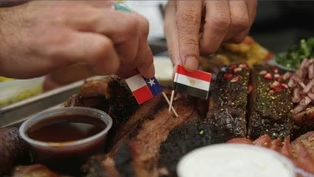
It's an iconically Texan quality to be independent, self-sufficient, and do what needs doing. This episode explores three distinct Texans who have taken matters into their own hands — a hunter helping his fellow ranchers, an Egyptian-born pitmaster who journeyed to Texas to make his mark in barbecue, and a pair of brothers trying to accurately document the fallen of The Forgotten War.
Problems playing video? | Closed Captioning Feedback
Problems playing video? | Closed Captioning Feedback
Production Support Provided By: H-E-B and Texas Parks & Wildlife Foundation
The Story: TAKING MATTERS INTO YOUR OWN HANDS
Episode 7 | 24m 36sVideo has Closed Captions
It's an iconically Texan quality to be independent, self-sufficient, and do what needs doing. This episode explores three distinct Texans who have taken matters into their own hands — a hunter helping his fellow ranchers, an Egyptian-born pitmaster who journeyed to Texas to make his mark in barbecue, and a pair of brothers trying to accurately document the fallen of The Forgotten War.
Problems playing video? | Closed Captioning Feedback
How to Watch Texas Monthly Presents: The Story
Texas Monthly Presents: The Story is available to stream on pbs.org and the free PBS App, available on iPhone, Apple TV, Android TV, Android smartphones, Amazon Fire TV, Amazon Fire Tablet, Roku, Samsung Smart TV, LG TV, and Vizio.
Providing Support for PBS.org
Learn Moreabout PBS online sponsorship(upbeat music) - [Michael] These two brothers have gone out of their way to save history.
- [Josh] Sometimes taking matters into your own hands is the only way forward.
(knife scratching) - [Daniel] Kareem's got so many layers to his own story.
- My family and my friends, I left everything behind.
- You know, if Eli isn't doing this.
It's not clear anybody else will.
- As a writer, when you find people like these guys, you have a good story.
(flags rustling) (lively music) (paper rustling) (wind whistling) (graphics clicking) (ominous music) - [Crew] So you're a killer now, huh?
- [Josh] Mm-hm.
Yeah, apparently I am.
I just take comfort in the fact that if there's one animal in Texas that deserves death, (laughs) it's probably the feral hog.
My name is Josh Alvarez.
I'm a senior writer with Texas Monthly, (graphics whooshing) and I wrote the story Hunting Feral Hogs by Any Means Necessary.
(gentle music) By day, Eli Smith (chisel rasping) is the leader of his Mormon church.
(saw rasping) He is this good upstanding man, (saw rasping continues) very active in his community.
(hammer thudding) He's a dotting husband (sander rasping) and a loving father to three young girls.
But when the sun goes down, Eli Smith becomes something else entirely.
(footsteps plodding) He becomes this vicious, sometimes cruel exterminator of feral hogs.
(dramatic music) Feral hogs are a huge problem.
There's millions of them across Texas.
They cause hundreds of millions of dollars of damage and extra expenditures on the part of landowners, (graphics whooshing) the creature's a menace.
It is invasive.
It could kill other animals.
They're almost like the Orcs of Texas.
They look like they're born out of mud.
They pollute waterways, rivers, they love to go in and rut farmland.
- I'm sitting there watching them knock down corn.
I'm sitting there watching them root up hay fields.
- They root your tanks up, root your roads up.
There's nothing good about the hogs.
- Farmers lose huge proportions of their crop yield every year to hogs and every acre matters.
So if hogs aren't dealt with, then for a lot of farmers, it's kind of the end of their ability to make a living the way that their families have for generations.
(footsteps plodding) - How are you sir?
- Good sir.
- Have y'all been seeing 'em quite a bit back in the back rooting and stuff?
- Yeah, good bit and they're even rooting up here by the house.
- Gotcha.
(ominous music) - [Josh] In effect, Texans are on their own.
There is no magic silver bullet for dealing with the hog problem.
- It's all hands on deck (gun clicking) and at the end of the day, it's just all that warfare on 'em.
- [Josh] I decided to go on a hunt because I like writing about adventure and I like writing about things that I have never done before.
So Eli invited me to come along and join him on a hunt to just see what it looks like.
I thought I would just witness Eli Smith do some hunting, kind of watch them go about their business.
But little did I know that Eli had some plans for me to actually participate.
(car engine revving) Eli is very talented at figuring out where they are and how to kill them most effectively.
- These are all hog tracks right here.
See that mud on that brush right there?
That's from a hog coming outta that fresh mud and they're going right up that trail.
You've gotta be strategic.
They're a smart animal.
You've gotta be out thinking them.
(dogs barking) - [Josh] It was full of moments of adrenaline and exhilaration.
You would hear the dogs barking and you would know that they had a sounder of hogs surrounded.
(bullets rattling) And in the end, you know, to go and get them, you have to just hike into these parts of land that are not meant for humans.
It is thick brush with cactus and thorns and rattlesnakes.
(leaves rustling) There's a lot of danger, just even walking and stalking in that land.
Not to mention the very thing you're hunting is very capable of committing serious harm.
Not only can hogs grow up to be 400 lbs, but their tusks are jagged and sharp and more than enough to disembowel a dog to the point of almost cutting them in half, which has happened several times.
(branches crackling) (dogs barking) (dramatic music) (dogs barking continues) But none of this happens without the dogs.
They're essential for hunting hogs in an effective way.
- They're the whole key to it.
I mean, this is as close to watching a wolf hunt an animal as you can get.
I mean this is nature at its best.
(dogs barking) - [Josh] They work as a pack, they work as a team to grab the pig and hold it in place long enough for the hunter to then approach and then stab the pig in the heart.
And stabbing a hog is what hunters call pig sticking.
And it's often just a matter of practicality.
When the dogs go bait them, they're often inside a really thick brush.
So if you were to try to shoot the pig, you're just as likely to hit a dog or even just miss entirely.
(hog bellowing) A good clean stab is actually a very effective way of killing a pig.
When it's done right, it's very quick.
Pigs are dead within 10 seconds.
(hog bellowing) I went on the first hunt (wind whistling) only expecting to watch.
I brought my phone, I brought my notes and I was just gonna take photos, take video and see them operate.
(somber music) But then things took a turn when it became my turn to participate.
Killing a hog by stabbing it is a intimate way of killing an animal.
I mean, you are right up close with it.
You are looking it in the eye.
It being a first time for me, I didn't really know what I was doing and I felt like I prolonged that particular pig's suffering.
Outside of fishing I'd never killed an animal until I'd done it that way.
And it was a really brutal way to do it.
And for a while I didn't know how to feel.
For the next couple of weeks, I was a bit disgusted.
Something strange happened, (footsteps plodding) (somber music) around two or three weeks after that hunt, I felt like I wanted to go back out with Eli and see it again and try it again.
I've come to the conclusion that hogs are such a problem, that there's no other way around it, they have to be killed.
And I think part of what attracts me to doing it again is to find a little bit of redemption, learn how to do it the right way, and then be able to do it effectively for others and for Texas itself.
(car engine revving) (gentle music) Eli has been doing this voluntarily for many years.
He has the constitution to deal with just the blood, (grass rustling) the guts, and the ugliness of it.
(dogs barking) (gun firing) (gun clicking) - Hey, come on.
- [Josh] This sense of looking out for his neighbor is kind of channeled into this aggression and this real deep-seated hatred for these animals that are causing so much harm to the people he cares about.
You know, if Eli isn't doing this, it's not clear anybody else will.
And so he has taken it upon himself to hunt these hogs and to help his neighbors out.
(paper rustling) (wind whistling) (gentle music) - [Daniel] When I started this job, (vegetables rattling) I would write a little bit about the restaurant and the restaurateur and a lot about the food.
I've really switched that (knife scratching) because the story of the people is just more interesting (crowd chattering) (gentle music continues) and the motivations of them (food sizzling) to go into this business (gloves rustling) is what interests me.
(cutlery jangling) - Thank you.
- [Daniel] Kareem has got so many layers to his own story, which makes the article that I wrote about him a lot less about the food at the restaurant than about his journey into Texas barbecue.
I'm Daniel Vaughn, the barbecue editor at Texas Monthly, and I wrote about KG BBQ.
KG BBQ's a barbecue food truck in Austin that blends Egyptian cuisine with traditional Texas barbecue techniques.
(upbeat music) (food sizzling) (crowd chattering) (cutlery jangling) KG BBQ is run by Kareem El-Ghayesh.
He is from Cairo, Egypt.
(graphics whooshing) The barbecue trailer is popular, but I think Kareem himself is more popular.
- Thank you.
- How is everything?
(indistinct) Hi, nice to meet you.
- This is amazing.
- Thank you.
- [Daniel] He has become quite a barbecue star.
(food sizzling) He's the Egyptian cowboy and along with the cowboy hat is that massive smile and mustache.
- Through barbecue and two stepping I think I earned my Texanship.
(laughs) (foil rustling) Alright, (knife scratching) you know what they say, right?
Brisket is king in Texas.
(cutlery jangling) - When I first listened to Kareem tell his story, it was sort of unbelievable.
(gentle music) (fire crackling) He came to Texas really just on a whim to visit.
- I just remember taking my first bite of brisket (latch squeaking) and my eyes rolling (food sizzling) in the back of my head and being just blown away by the experience.
I really think it's magical.
- Kareem loves it and wants to figure out how to cook it.
So he went back to Egypt with the goal of really learning how to cook Texas barbecue.
(hooters blaring) But the first challenge he found was finding any butcher who knew what a brisket was.
And then the only smoker he could find was a Weber.
So he had to practice on equipment that maybe wasn't so suited for such a big cut of meat.
Working with meat that was much less fatty than we have here in the States.
You know, it could have been pretty demoralizing.
Like this doesn't taste anything like what I remember.
And you know, that might've been the the time to quit, to just fold and go back to finance.
Pretty soon he realized that his future in barbecue needed to be back here in Texas.
(plane engine revving) (tires squeaking) So you got this finance guy in Egypt (latch squeaking) and he abandons it all.
(hinges squeaking) I mean, he comes to the US to live the life of a popper.
- I left a lot behind in Cairo.
(gentle music) You know, that was a really tough move for me, my family and my friends, my people.
My support system is back home.
I questioned my life decisions a lot in the beginning because I left everything behind earning nothing.
- [Daniel] He was trying to knock on every pit room door that he could find in Austin to see if somebody would hire him or just let him come work in the pit room for free.
But the doors really kept closing on him.
Kareem was considering going back home, giving up on the dream.
- Without seeing any outcome.
My only fuel and my only light was the belief in myself.
- He'd given himself one more weekend to search.
(graphics whooshing) and Bill Kerlin of Kerlin BBQ finally let him in the pit room and let him work there and gave him the tutelage that he needed to take on Texas barbecue.
Eventually, (upbeat music) he starts making money and opened KG BBQ in 2022.
The greatest decision he could have made for KG BBQ was to not just replicate the barbecue from all these places he had worked at.
His concept was to take all the things that he knew and loved from cooking with his family in Egypt and pair that with smoked meats.
- This is something that is so close to our hearts and I think that shows in our food.
(lively music) - [Daniel] I had never really seen any sort of Egyptian take on barbecue.
(fire crackling) I had heard so many great things about it and really just blew us away with how great the food was.
The Rice Bowl has turmeric infused rice.
It's got barbecue on top, but the thing is, it's got all these different garnishes that are so unusual when comes to barbecue.
- Look at this, beautiful pommies.
It's the essence of our food and it works really well.
It's not something that you find in barbecue joints here.
- [Daniel] One of the really rare things that Kareem does, and it's really a throwback, is cooking lamb.
Lamb used to be a really big part of Texas barbecue and that's really gone by the wayside.
Opening up a barbecue operation is a big risk anytime.
But he knew that if he wanted to make this happen, it was gonna be him to make it happen.
The fact that he was doing it all in a strange land away from his family and away from what would've been a comfortable life back in Egypt makes it even more remarkable.
(paper rustling) (wind whistling) (ominous music) - [Michael] There's something just so awful about giving your life for your country (gun firing) (gun firing continues) and then being forgotten or being disrespected, (paper whooshing) but these two brothers in Dallas have gone out of their way to save history.
(camera clicking) And paid honor to these folks who died for their country.
My name is Michael Hall, I'm a staff writer at Texas Monthly, and I wrote, (graphics whooshing) Forgotten No More.
(footsteps plodding) We are in the grounds of the Texas State Capitol in the shadow of the Capitol building.
And there are numerous war memorials here, including the Korean War Memorial.
(somber music) There are monuments to the Korean War dead in California, in Korea, and in Washington DC, and they all have terrible mistakes on them.
They all have misspelled names and they all have names that shouldn't be there, and they are lacking names that should be there.
(plane engine revving) (missile booming) (canon firing) (guns firing) The Korean War was 1950 to 1953, and even though 37,000 Americans died in it, the Korean War is often called the forgotten war.
But there are plenty of people who can't forget it.
And I'm one of those people because my dad was a Korean War veteran.
During the Korean War, he had been a medic at one of the biggest battles.
It was called Chipyong-ni.
But when the US Army got together to write the history of this battle, they basically wrote out the contributions of all the doctors, including my dad.
(car door latch clicking) So my dad spent 20 years of his life trying to get the Army to correct the record and the Army wouldn't do that.
(footsteps plodding) (door thudding) (dogs barking) And it was during this time that my dad got to know Hal and Ted Barker.
(door latch clicking) Smile you're on Candid Camera.
Hey guys.
The Barker Brothers are Hal and Ted Barker, two brothers who live in the same apartment near White Rock Lake in Dallas.
For the last several decades, Hal and Ted have basically been crowdsourcing the Korean War.
- Well, since 1979, my brother has been living this obsession of his and I got sucked into this in 1988 and there'd been no way out.
(upbeat music) Everywhere you look in our closets and our garage, it's Korea.
That's Korea, that's Korea, that's Korea.
(switch clicking) In here at the throne is Korea.
- The Barker Brothers had one of the very first commercial websites in Dallas back in the mid '90s called the Korean War Project.
- Started in February, 1995.
We're basically now the longest continuous operating website in this part of the country.
We got millions of pages of documents, thousands of photographs, tens of thousands of data inputs.
It's allowed us to be the main interactive website for the Korean War on the internet.
- My dad went online and found the Korean War Project, so they took all my dad's information and they gave him his own webpage.
It was really compelling for someone like my dad who was just trying to find any way to not be forgotten.
One of the things that I learned from talking to the Barker Brothers is that there were thousands of men and women like my dad, whose stories had either not been told or they'd been told incorrectly or they'd just been completely forgotten.
(gentle music) - I tried to find out about my father and in turn I found out about a whole generation of heroes.
- [Michael] As they're crowdsourcing this history of the war, they realize that they are collecting the most complete database of the dead from the war.
This was not long after the Vietnam Memorial Wall was installed in Washington DC, (graphics whooshing) So Hal was talking with all these Korean war vets and they were like, "Why can't we get a wall?"
- I founded the Korean War Memorial Trust Fund in 1984, and then it turned into the Korean War Veterans Memorial on the mall.
- [Michael] That eventually goes up in 1995.
There's no wall yet though.
So Hal and Ted keep trying to get this wall devoted to the Korean War dead, which we've given to the dead and the veterans of Vietnam.
Years later, Congress passes a law in 2016 creating the wall, but part of the bill is that the source of these names is the Department of Defense.
So in 2011, the National Archives puts a list up on its website with the names of all the Korean War Dead.
It's this list from the National Archives that is ultimately going to be the final list of names on the wall, and Hal and Ted go and look at it and lo and behold, there are all kinds of mistakes on it.
(dramatic music) So it's like this constant battle for the Barkers, going up against the bureaucracy, going up against the red tape, trying to fix this list.
- What we have been doing for years is trying to convince the Department of Defense to pay attention to the facts.
On this wall here, these are names that are not officially recognized by the Department of Defense.
In many cases, for example, an aircraft would crash and the Department of Defense would only list part of the crew as killed and left the rest off.
All the red here represent losses outside of the combat zone.
All these represented in blue are actual losses that occurred in the same locations, but are not on the list.
(paper rustling) These here, the Department of Defense does not consider these to be Korean War losses.
We do.
(paper rustling) We've been trying to convince them otherwise, but they will not have any contact with us whatsoever, and I don't think they ever intend to.
(gentle music) - [Michael] So there was a foundation that was responsible for building the memorial wall, and they reached out to Hal about using his database for their wall, but they could not come to an agreement.
Hal said that they only offered him 200 bucks for all that work, all those names.
He felt insulted by the low ball offers for what was essentially his life's work.
- I could be making $150 an hour as a programmer, but I'm not.
I could make more money going working at McDonald's.
- [Michael] He said that when he came up with a counter proposal, we'll give you the names if you print them in a book, they said it was too expensive.
So the whole deal fell through.
And all of this is according to Hal because I was never able to talk to the head of the foundation because by the time we set up an interview, he died.
He was 96.
The end result was the foundation was not going to use the Barker's list.
What they were gonna use was the list provided by the Department of Defense.
So Hal and Ted's data was not going to be leading to an accurate wall.
- And now they have a $25 million disaster on the mall.
(flags rustling) (somber music) - [Michael] So the official ceremony opening to the wall was in July, 2022.
Mistakes and all.
We're talking about more than a thousand errors here.
Ambrosio Guillen from El Paso died heroically.
- Medal of Honor.
(Michael laughs) Guillen is a Medal of Honor winner and they have his name misspelled on the Korean War wall.
On the wall.
They misspelled his last name.
It's Ambrosio Guilien.
(somber music continues) What is G-U-I-L-I-E-N?
It's G-U-I-L-L-E-N.
And I notified the DOD of this in 1996.
There's over a thousand like that.
- A name is the only thing you really have left in death.
The least we can do is get their names right.
Ambrosio Guillen's name is misspelled here in Austin.
It's the same misspelling that is on the wall in Washington DC.
Have you guys been to the wall yet?
The wall?
- No.
I'll never go.
- Hmm.
- Never.
- I would not go.
- What would it take for you guys to go?
- Tear it down.
- [Michael] The Barker brothers knew the only way these fallen heroes were going to be honored for what they had given up was if they did it themselves.
(lively music) So they found a backer and they printed up their own book with their accurate list of the Korean War dead.
It was just this simple little book, no pictures, no anecdotes, but just the names properly spelled.
- It's just taking us 30 years plus to put this information together.
This is our best effort (hands thudding) and we continue to add to it.
(paper rustling) - [Michael] One of the great things about stories like this is you see these folks taking things into their own hands because it's the right thing to do.
(footsteps plodding) - [Josh] I like writing about adventure.
(car door thudding) And I like writing about individual efforts by Texans who are self-reliant.
It's part of the ethos of Texas that when there's a problem, (bullets rattling) that you just find a way to deal with it.
(dogs barking) (gun firing) And sometimes taking matters into your own hands is the only way forward.
(fire crackling) - [Daniel] Being able to meet people who have this strong motivation to serve people, to run a restaurant, (knife thumping) is really what makes me enjoy the job more than anything else.
- [Michael] As a writer, when you find people like these guys, you know- - [Daniel] You have a good story.
(graphics booming)
TAKING MATTERS INTO YOUR OWN HANDS Preview
Video has Closed Captions
Preview: Ep7 | 30s | Discover three stories of distinct Texans who have taken matters into their own hands. (30s)
Providing Support for PBS.org
Learn Moreabout PBS online sponsorship











Support for PBS provided by:
Production Support Provided By: H-E-B and Texas Parks & Wildlife Foundation