
Nikole Hannah-Jones on her consequential school choice
Clip: 9/29/2026 | 8m 11sVideo has Closed Captions
Nikole Hannah-Jones reflects on her daughter's school experience
For decades, Pulitzer Prize-winning journalist Nikole Hannah-Jones has reported on race, inequality and the deep divisions in American education. In a new essay, she turns the lens on a choice she made for her own family: sending her daughter to a high-poverty, low-performing school in Brooklyn. Geoff Bennett spoke with Hannah-Jones about the decision on our PBS News podcast, "Settle In."
Problems playing video? | Closed Captioning Feedback
Problems playing video? | Closed Captioning Feedback
Major corporate funding for the PBS News Hour is provided by BDO, BNSF, Consumer Cellular, American Cruise Lines, and Raymond James. Funding for the PBS NewsHour Weekend is provided by...
Nikole Hannah-Jones on her consequential school choice
Clip: 9/29/2026 | 8m 11sVideo has Closed Captions
For decades, Pulitzer Prize-winning journalist Nikole Hannah-Jones has reported on race, inequality and the deep divisions in American education. In a new essay, she turns the lens on a choice she made for her own family: sending her daughter to a high-poverty, low-performing school in Brooklyn. Geoff Bennett spoke with Hannah-Jones about the decision on our PBS News podcast, "Settle In."
Problems playing video? | Closed Captioning Feedback
Where to Watch PBS News Hour
PBS News Hour is available to stream on pbs.org and the PBS app.
Providing Support for PBS.org
Learn Moreabout PBS online sponsorshipGEOFF BENNETT: For decades, Pulitzer Prize-winning journalist Nikole Hannah-Jones has reported on race, inequality, and the vast divisions in American education.
But in a deeply personal new essay, she turns the lens on a choice she made for her own family, sending her daughter to a high-poverty, low-performing school in Brooklyn.
It was a decision rooted in her belief that families with choices have a role to play in making sure that all children receive a quality education.
But, years later, her daughter says that choice came at a cost.
I spoke with Nikole Hannah-Jones about the tension between principle and parenthood.
Here's part of that conversation for our video podcast "Settle In."
In this piece, you write that there were warning signs about your daughter's schooling fairly early.
There were the chaotic lunchroom, the absent teachers, the unanswered e-mails.
And then, in fourth grade, you discovered that much of her math work was wrong and in many cases hadn't even been graded.
That for a lot of people would have been a rip cord moment.
But I hear you when you say that you believe in the collective good and that, for -- to leave that school would have been giving up on all of those kids.
Is that why you stayed?
NIKOLE HANNAH-JONES, "The New York Times Magazine": Yes, so let me again -- it's a single essay, so it can't tell every nuance of the story for 10 years.
If you read it paired with the first essay, which was even longer than this one, you will know that, when we picked that school -- so what some folks have said is, oh, she went and picked the worst school she could find so she could make a point.
That's not true.
When we picked that school, it was led by a dynamic principal named Roberta Davenport, who had grown up in the housing projects across the street.
She had turned that school into a magnet school to try to draw in middle-class parents to socioeconomically integrate the school.
When I started that school in pre-K, it's - - that school had Mandarin.
My daughter was taking Mandarin in pre-K.
There was a cohort of middle-class parents who came in with us.
They were there through pre-K and kindergarten.
She had excellent teachers really the first three years.
Even the lunchroom scene, again, I have spent more time in schools than most people have.
So I know it is the least unusual thing to see kids in first, second, and third grade acting rambunctious in a lunchroom.
What was the problem was the adults who were not doing any correction, right?
But my daughter's classroom teacher, she was still getting an amazing education at that point.
So, no, I wasn't going to leave because I saw something wrong in the school.
What I did was, I addressed and made the principal address what was wrong in the school.
But as we went further along in the school, by first grade, all the white parents had left the school except for one.
And by third grade, almost all the Black middle-class parents had left the school.
But, by then, we have now been at the school for five years.
We know the families.
We know the children.
My husband was a Title I -- on the Title I task force.
He was on the school leadership team.
He was on the PTA.
He was a parent organizer.
We were invested.
We had relationships and a sense of ownership over this school.
So, no, we didn't leave.
And I get people saying they would have taken their child out.
If you read the essay, we struggled with it.
We had many conversations, emotional conversations, and all we kept thinking is, we can rescue our child from this, but what about the other kids?
There were 300 other children in that school.
And I get that the instinct, and it was my instinct as well, is to say, you know what, I feel for them, but I got to save my own child.
But, in the end, we just couldn't live with that decision.
And it just -- it didn't feel right.
We had to try to fight for the other kids in our community.
GEOFF BENNETT: Say more about that, because you're right.
I think most people would say, when an act of solidarity with other people's children becomes an unacceptable gamble for my own child, my own child will always win out.
I think it's really hard for people to understand that perspective.
NIKOLE HANNAH-JONES: Yes.
I mean, look, I know that it is.
I don't expect people to.
I -- one thing I realize is that, and I have always said this, it's easy to have values when you're not confronted with actually having to live them.
And that's for all of us on a whole bunch of things.
There are things that I'm absolutely hypocritical on, and there's things that I really, really believe in that I try really hard to live out those values.
If it went smooth the entire time, the values would be easy.
It's when you're really confronted with the challenges of a system that you have documented as doing exactly this for 20 years that you have to decide, who am I?
What are the values?
Now, again, when my daughter got older, I had to grapple with her saying, that hurt me.
And I have to live with that as a parent.
And I have had to publicly try to grapple with that in the last week.
But I don't know what else to say, except that I just don't believe -- I just believe strongly that we have to try to do better for all of our kids.
And I know, in the abstract -- I have heard this 1,000 times -- well, there were other ways to support these schools.
You could have -- could have done other things.
And then I always point to, then why haven't we done it?
In New York, in Brooklyn, there's a majority-Black middle school.
It is where most of the Black middle-class parents in my area send their kids to.
This school can raise hundreds of thousands of dollars every year for its PTA.
I haven't seen an effort to say, well, let's take 20 percent of that money and give it to this low-income school, like my daughter's school, that raised $2,000 if we were lucky.
I'm not saying they should do that.
But what I am saying is, if we don't have skin in the game, it's all just -- it's all theoretical.
We all like to believe that we're going to support our needier neighbors, but we just don't.
So, yes, were there -- were there many times where my husband and I were like, can we stick this out, are we doing the right thing, can we mitigate this enough for our child?
Yes.
Was it worth trying?
Yes.
Are we the product of people who made personal sacrifice?
Absolutely, right?
The fact that you and I can even have a discussion about choice, about where to send our child, whether we can put our child in these majority-white schools is because other people were willing to make a personal sacrifice of their own children sometimes, right, their own children's education, for that to happen.
I just, maybe more than most, feel a deep connection to that struggle.
I mean, I spent my life studying it.
I have spent my life talking to the people who made that sacrifice.
And it's always been a few of us.
It's never been most.
And that's OK.
So I get that people won't understand that.
It is the most unnatural thing in the world, right, to not put your child ahead of every other child in every area.
It is unnatural.
It was unnatural for us.
That's why we cried about it many nights.
It's why we had long discussions.
But I'm also looking at the other kids in her classroom who are just as deserving.
And it just never felt right to just leave them behind because we could.
And that's all I can say.
The answer won't change.
It's like I told my daughter: "You can ask me a million times, but the answer is the answer."
GEOFF BENNETT: And you can watch that full conversation and more from our "Settle In" podcast on our PBS News YouTube page or wherever you get your podcasts.
 New
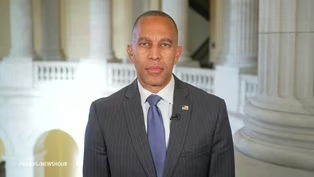
NewAffordability top priority if Dems take House, Jeffries says
Video has Closed Captions
Affordability and accountability top priorities if Democrats take House, Jeffries says (7m 51s)
 New
NewAyad Akhtar blurs fiction and reality in 'The Radiance'
Video has Closed Captions
Ayad Akhtar blurs fiction and reality in new novel, 'The Radiance' (6m 31s)
 New
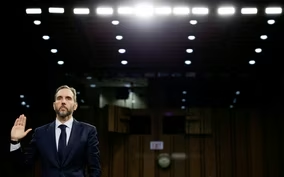
NewJack Smith defends criminal investigations of Trump
Video has Closed Captions
During Senate hearing, Jack Smith defends criminal investigations of Trump (3m 36s)
 New
NewNews Wrap: Supreme Court allows third-country deportations
Video has Closed Captions
News Wrap: Supreme Court allows Trump's deportations to third countries, for now (6m 17s)
 New
NewPoland braces for potential confrontation with Russia
Video has Closed Captions
Poland braces for potential confrontation as Russia tests NATO defenses (7m 24s)
 New
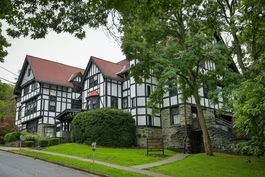
NewProsecutors reopen Cornell University rape investigation
Video has Closed Captions
New York prosecutors reopen investigation into alleged rape at Cornell University (5m 55s)
 New
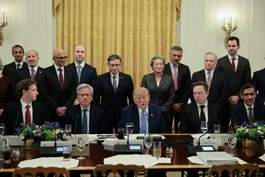
NewSelf-regulation 'not enough' for AI safety, Gary Marcus says
Video has Closed Captions
Self-regulation 'not enough' for AI safety, Gary Marcus says (6m 37s)
Providing Support for PBS.org
Learn Moreabout PBS online sponsorship New Episode
- News and Public Affairs

Today's top journalists discuss Washington's current political events and public affairs.
 New Episode
- News and Public Affairs

FRONTLINE is investigative journalism that questions, explains and changes our world.
 New Season
 New Episode
 New Episode
 New Episode
 New Episode
 New Episode

 New Episode
 New Episode
 New Episode
Support for PBS provided by:
Major corporate funding for the PBS News Hour is provided by BDO, BNSF, Consumer Cellular, American Cruise Lines, and Raymond James. Funding for the PBS NewsHour Weekend is provided by...