
March 16, 2026 - PBS News Hour full episode
3/16/2026 | 56m 44sVideo has Closed Captions
March 16, 2026 - PBS News Hour full episode
Monday on the News Hour, President Trump scolds allies for not helping protect oil tankers from Iran and talks to PBS News in a phone call about the war and oil prices. Ordinary Iranians share audio messages about life in the midst of the ongoing war. Plus, an increase in anti-Islamic rhetoric from Republican politicians raises concerns about religious hatred and potential violence.
Problems playing video? | Closed Captioning Feedback
Problems playing video? | Closed Captioning Feedback
Major corporate funding for the PBS News Hour is provided by BDO, BNSF, Consumer Cellular, American Cruise Lines, and Raymond James. Funding for the PBS NewsHour Weekend is provided by...
Support provided by:

March 16, 2026 - PBS News Hour full episode
3/16/2026 | 56m 44sVideo has Closed Captions
Monday on the News Hour, President Trump scolds allies for not helping protect oil tankers from Iran and talks to PBS News in a phone call about the war and oil prices. Ordinary Iranians share audio messages about life in the midst of the ongoing war. Plus, an increase in anti-Islamic rhetoric from Republican politicians raises concerns about religious hatred and potential violence.
Problems playing video? | Closed Captioning Feedback
How to Watch PBS News Hour
PBS News Hour is available to stream on pbs.org and the free PBS App, available on iPhone, Apple TV, Android TV, Android smartphones, Amazon Fire TV, Amazon Fire Tablet, Roku, Samsung Smart TV, and Vizio.
Providing Support for PBS.org
Learn Moreabout PBS online sponsorshipGEOFF BENNETT: Good evening.
I'm Geoff Bennett.
AMNA NAWAZ: And I'm Amna Nawaz.
On the "News Hour" tonight: President Trump scolds allies for not helping protect oil tankers from Iran and talks to the "News Hour" in a phone call about the war and oil prices.
GEOFF BENNETT: Ordinary Iranians share audio messages about life in the midst of the ongoing war.
MAN (through translator): Being bombed is a truly terrifying sound.
No matter how much you feel you're getting used to it, every time you hear it, it haunts you.
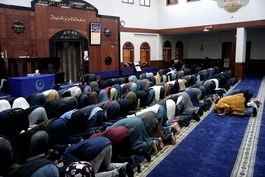
AMNA NAWAZ: And an increase in anti-Islamic rhetoric from Republican politicians raises concerns about religious hatred and potential violence.
MAYA BERRY, Executive Director, Arab American Institute: There's certainly, I think, a decision among some that this rhetoric is helpful.
It gives them viral moments.
It helps them raise money.
(BREAK) AMNA NAWAZ: Welcome to the "News Hour."
The war with Iran has entered its third week.
Shipping traffic through the critical Strait of Hormuz remains effectively shut off, and the shockwaves to the global supply chain of oil are being felt here at home with gas prices on the rise.
GEOFF BENNETT: President Trump himself is demanding help from U.S.
allies to secure the strait.
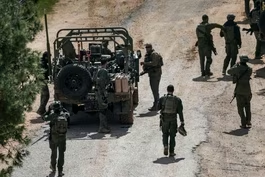
Meantime, Israel has announced yet another front in the war, a ground operation in Lebanon.
Nick Schifrin starts us off.
NICK SCHIFRIN: In Southern Beirut today, an Israeli bombardment.
By day, in the capital's southern suburbs from where Hezbollah operates, the buildings have been obliterated, this block left smoldering and shattered.
And, today, for the first time since the war with Iran started, Israel launched what it called limited targeted ground operations in Lebanon's south.
The new offensive has already emptied southern cities and sparked the evacuation of more than one million people, who will not be allowed to return to their homes any time soon, Defense Minister Israel Katz warned today.
ISRAEL KATZ, Israeli Defense Minister (through translator): Prime Minister Netanyahu and I have instructed the IDF to act and destroy the terror infrastructure near the border in Lebanon, just as it was done against Hamas in Gaza.
NICK SCHIFRIN: And Israeli and American strikes continue to target Iran.
Israel today admitted it struck Iran's electricity grid, but said it was colocated with an intelligence center, while U.S.
strikes continue to target Iran's missiles and drones, whose launches are down more than 90 percent.
DONALD TRUMP, President of the United States: This is a paper tiger that we're dealing with now.
It wasn't a paper tiger two weeks ago.
It's a paper tiger now.
NICK SCHIFRIN: In Washington, President Trump described Iran as increasingly weak, but he acknowledged that he approached half-a-dozen countries for help securing the Strait of Hormuz, through which 20 percent of the world's oil and natural gas flows and Iran has effectively shut with its attacks.
DONALD TRUMP: Many of the Europeans get quite a bit.
South Korea gets 35 percent.
So we want them to come and help us with the strait.
Some are very enthusiastic and some are less than enthusiastic.
And I assume some will not do it.
I think we have one or two that will not do it that we've been protecting for about 40 years at tens of billions of dollars.
NICK SCHIFRIN: But, in Europe, that implicit threat failed to inspire immediate action.
British Prime Minister Keir Starmer: KEIR STARMER, British Prime Minister: So, we're working with all of our allies, including our European partners, to bring together a viable collective plan.
NICK SCHIFRIN: And a European official goes further, telling PBS NewsHour that, while the war is ongoing, no European countries are interested in deploying military assets to help secure the Persian Gulf.
DONALD TRUMP: Why are we protecting countries that don't protect us?
And I've always felt that was a weakness of NATO.
We were going to protect them, but I always said, when in need, they won't protect us.
We don't need them, but it's interesting.
I'm almost doing it, in some cases, not because we need them, but because I want to find out how they react.
NICK SCHIFRIN: The U.S.
isn't only appealing to European allies.
Today, Japanese Prime Minister Sanae Takaichi said she had not received any formal U.S.
request yet.
And the country that buys the most Iranian oil and imports the most oil from the Gulf is China.
President Trump was supposed to leave for Beijing to meet Chinese President Xi Jinping spending two weeks from today.
But, today, he confirmed he wanted to delay the trip by a month.
DONALD TRUMP: We're speaking to China.
I'd love to, but, because of the war, I want to be here.
NICK SCHIFRIN: And so the war's effects continue to spread.
Brent crude prices remain above $100 a barrel, and American gas prices are nearly $1 more expensive per gallon than just one month ago.
Iran is trying to maintain that financial pressure with attacks on Gulf oil facilities.
Today and over the weekend, it struck a key Emirati oil export terminal.
But Iran also continued to target Gulf civilian sites, today, a fuel tank next to Dubai International Airport, the busiest in the world for international travel.
These attacks will continue and Iran will not negotiate, Foreign Minister Abbas Araghchi said today.
ABBAS ARAGHCHI, Iranian Foreign Minister (through translator): We're not asking for a cease-fire.
This war must come to an end in a way that it will not be repeated again.
NICK SCHIFRIN: And despite previous declarations of victory, that mirrors President Trump's vow to keep the war going until the U.S.
won't have to go back and repeat it again.
For the "PBS News Hour," I'm Nick Schifrin.
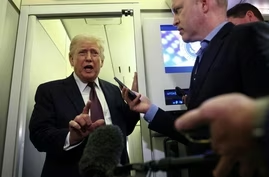
GEOFF BENNETT: This morning, our White House correspondent, Liz Landers, spoke on the phone with President Trump while the president was attending what he described as a very important meeting on the Iran war.
Liz joins us now.
OK, Liz, so how did this phone call come about, and what did you ask the president about?
LIZ LANDERS: Well, Geoff, we have been talking about how the president has had very unconventional messaging in the last few weeks since this conflict started, and he has been picking up the phone when reporters have called him and asked questions about Iran.
I called him around 8:00 a.m.
this morning.
We spoke for just three minutes.
It was a very fast call.
He said when he picked up that he was in a very important meeting, but he did make some comments and I was able to ask him some follow-up questions.
He reiterated to me that he believes that the Iranian military has been decimated.
He said that, they want to make a deal, the Iranians, "But they're not ready to make a deal, in my opinion."
And he talked a little bit more about that military strike that happened at the end of last week on Kharg Island.
This is a big terminal for Iranian oil.
It's their main hub for their oil exports.
Like, 90 percent of their oil exports go through here, so very strategic location.
He said that that is out of commission now, except for the pipes, saying that the United States in those military strikes did leave some of that oil infrastructure there.
But he did threaten to hit Kharg Island again and said that he would knock the hell out of it if Iran does not cooperate going forward.
He also talked about the infrastructure in Tehran, saying that, right now, that city, the United States, has not hit electric plants there.
He said he could knock out electric plants, but that that would include years of rebuilding and also trauma.
So, he said -- quote -- "I'm trying to hold off on that kind of thing right now."
GEOFF BENNETT: And you also asked him about rising oil prices?
What did he say?
LIZ LANDERS: Yes, well, yesterday, we had seen Secretary Wright, the energy secretary, out on the Sunday shows talking about this.
Americans are seeing this at the gas pump right now.
So I asked the president about those oil prices rising.
He said that it's a -- quote -- "very small price to pay" for what he described as more than four decades of terror from the regime.
But he did predict that those oil prices will -- quote -- "drop like a rock" as soon as the war is over.
He said: "I don't believe it will be long," so giving kind of an update on the timeline there.
My final question to him was about American troops on the ground.
He has been asked repeatedly if the U.S.
will send troops to the region.
And, last week, we heard from a Democratic Senator, Dick Blumenthal of Connecticut, who came out of this briefing, was sounding the alarm bells that he thinks that the administration is preparing to put troops on the ground.
The president didn't want to weigh in on that with me.
When I asked if his thinking around this topic has changed at all in the last few days, he said: "No.
I just don't want to talk strategy with a reporter," Geoff.
GEOFF BENNETT: OK, Liz Landers, terrific reporting.
Thank you.
LIZ LANDERS: Thanks.
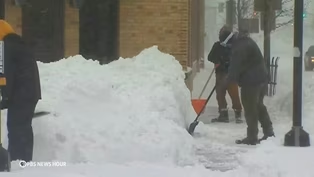
AMNA NAWAZ: In the day's other headlines: More than half of the country is experiencing some form of rough weather today.
Blizzards, extreme winds or unexpected heat disrupted life from the Northeast to the Hawaiian Islands.
William Brangham has the details.
WILLIAM BRANGHAM: It was March madness of a different kind today, as this chaotic weather system delayed tens of thousands of travelers nationwide.
It's an extra layer of stress for airports, where TSA agents who are missing paychecks are already calling out from work during this partial shutdown.
JAMES KELLER, Traveler: Watching the storm move across the country, it's gained a lot of power for sure.
WILLIAM BRANGHAM: James Keller was trying to make it home from North Carolina to New York today.
JAMES KELLER: We talked about running a car, but the reality is, we're just chasing the storm up the entire East Coast.
WILLIAM BRANGHAM: The D.C.
metro area was at the center of a long stretch of the East Coast on alert today from an intense storm that threatened winds above 75 miles an hour and potential tornadoes.
The area most at risk covered South Carolina up to Maryland.
The storm is expected to pass before Tuesday, but will leave a bitter chill in its wake.
Windchills below freezing are expected across the Southeast tomorrow.
And the Upper Midwest is still digging out from a major dumping of snow over the weekend.
Parts of Minnesota, Wisconsin and Michigan were buried under nearly two feet, with some still falling today.
While parts of northern Illinois were under a blizzard warning last night, thunderstorms flooded Chicago streets.
MAN: We have some major damage to South Kihei Road.
WILLIAM BRANGHAM: An ocean away, Maui's streets were similarly drenched from a separate storm.
The National Weather Service said the Hawaiian island was deluged by more than 23 inches of rain, almost two feet of water on Saturday.
Flooding was also reported on the Big Island and Oahu.
But then a hot summer came early to Southern California.
DANIELA URIOSTEGUI, Riverside, California, Resident: I mean, it's a little weird, a little different.
WILLIAM BRANGHAM: Long Beach is usually in the upper 60s and low 70s this time of year, but a heat wave set a record of 92 degrees last Thursday.
CONNIE PATTERSON, Long Beach, California, Resident: I'm doing pretty good.
I just keep the windows and fans on.
WILLIAM BRANGHAM: For the "PBS News Hour," I'm William Brangham.
AMNA NAWAZ: Also today, a federal judge in Massachusetts temporarily blocked federal health officials from overhauling the nation's vaccine policies.
It's a major blow to the Trump administration's broader health agenda.
The judge sided with major medical associations in finding that Health Secretary Robert F. Kennedy Jr.
likely violated federal procedures in revamping an important vaccine advisory committee.
He put on hold decisions made by that board, including which vaccines children get and when.
The government is expected to appeal.
But the president of the American Academy of Pediatrics celebrated today's ruling, calling it -- quote -- "an historic and welcome outcome for children, communities, and pediatricians everywhere."
President Trump announced that his chief of staff, Susie Wiles, has been diagnosed with early stage breast cancer.
In a social media post, Trump said "Her prognosis is excellent and that she will continue doing the job she loves and does so well while undergoing treatment."
Shortly after that post, Wiles received a warm welcome at a White House event wearing a pink blazer, a color associated with breast cancer awareness.
The announcement comes at a pivotal time for the Trump White House as it manages the war with Iran and prepares for the upcoming midterm elections.
At that same event, President Trump revealed a separate diagnosis, this time for Florida Congressman Neal Dunn, saying he had a terminal diagnosis due to a heart problem.
Trump described how he intervened in Dunn's medical care, which led to this moment with House Speaker Mike Johnson.
REP.
MIKE JOHNSON (R-LA): Congressman Dunn is a real champion and a patriot because he's still coming to work.
And if others got this diagnosis, they would be apt to go home and retire.
DONALD TRUMP, President of the United States: What was the diagnosis?
REP.
MIKE JOHNSON: It was -- I mean, I think it was a terminal diagnosis.
DONALD TRUMP: He would be dead by June.
REP.
MIKE JOHNSON: OK, that wasn't public, but yes, OK.
AMNA NAWAZ: Both Johnson and Trump went on to say that, since treatment, Dunn is acting as though he has -- quote -- "a new lease on life."
Earlier this year, the congressman said he would not seek reelection amid rumors over the severity of his condition, though he does plan to see out his current term.
The Kennedy Center board voted today to close the Washington, D.C., art space for a two-year renovation project.
The center's trustees, who were handpicked by President Trump, agreed that the work will begin after this year's July 4 celebrations.
The renovation plan has drawn criticism from Democrats and has been contested in court.
The board also voted to install Matt Floca as the new executive director.
He replaces Richard Grenell, a close Trump ally who had overseen a tumultuous year, with Trump's name added to the center and a number of artist cancellations and staff departures.
In Cuba, officials are investigating a - - quote -- "complete disconnection" of the country's electrical system, leaving its 11 million residents without power.
It's the country's second blackout this month, with officials blaming the ongoing U.S.
energy blockade for adding pressure to Cuba's already strained energy sector.
On Friday, President Miguel Diaz-Canel said the island had not received oil shipments in more than three months, but he added that officials have entered talks with the U.S.
with the goal of ending the crisis.
There are reports today that the first in a series of meetings took place this weekend between Hamas and envoys from President Trump's Board of Peace.
That comes as hospital officials in Gaza say that Israeli airstrikes killed at least 12 people yesterday, including two children and a pregnant woman.
Israel's military says it was responding to an earlier incident when a Hamas militant opened fire on Israeli troops.
All this comes as a sandstorm swept through refugee camps in Southern and Central Gaza over the weekend, only adding to the misery for the displaced Palestinians living there.
IBRAHIM JARGHOUN, Displaced Palestinian (through translator): Two years of war and we are in the third year.
It's unbearable.
We are tired.
Look at us with compassion, with kindness.
Have mercy on us.
What is happening is unjust.
Enough already.
AMNA NAWAZ: Separately, Israel announced it will reopen Gaza's Rafah Crossing with Egypt starting Wednesday after a more-than-two-week closure.
Since it opened earlier this year, a limited number of patients have been allowed outside Gaza for treatment, but Gaza's Health Ministry says thousands more need to be evacuated.
On Wall Street today, stocks posted solid gains to start the week, despite those ongoing worries about oil prices.
The Dow Jones industrial average added nearly 400 points on the day.
The Nasdaq rose almost 270 points, or more than 1 percent.
The S&P 500 posted its biggest gain in five weeks.
And after nearly three decades of nominations, filmmaker Paul Thomas Anderson finally has an Oscar.
NICOLE KIDMAN, Actress: The Oscar goes to "One Battle After Another."
(CHEERING) AMNA NAWAZ: His movie "One Battle After Another" took home six awards last night, including best picture and best director.
The top acting prizes went to Jessie Buckley, who played the grieving wife of William Shakespeare in "Hamnet," and Michael B. Jordan for his portrayal of twin mobsters in "Sinners."
The blues-infused horror movie also won for best cinematography, a historic win for Autumn Durald Arkapaw.
AUTUMN DURALD ARKAPAW, Cinematographer: I really want all the women in the room to stand up, because I feel like I don't get here without you guys.
(CHEERING) AMNA NAWAZ: She became the first woman to ever win that category and the first person of color.
Still to come on the "News Hour": President Trump faces pushback from allies in his war with Iran; Iranians describe living in the midst of the ongoing war; and Tamara Keith and Amy Walter break down the latest political headlines.
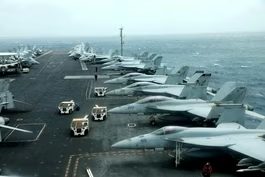
Iran is still blocking the Strait of Hormuz, a critical shipping lane, and President Trump is now demanding that NATO allies act to help reopen it.
For two views on this and the larger war, we turn now to retired vice admiral Kevin Donegan.
He's former commander of the U.S.
Fifth Fleet, which operates in the Middle East.
He's now a distinguished military fellow at the Middle East Institute.
And Nathalie Tocci, she's professor of practice at the Johns Hopkins University School of Advanced International Studies in Europe.
Welcome to you both.
And, Nathalie, I will begin with you.
How do the European allies feel about President Trump calling on them to help the U.S.
and to get involved in the Strait of Hormuz?
NATHALIE TOCCI, Johns Hopkins University School of Advanced International Studies: Well, they have very little intention of getting dragged into a war, which they didn't participate in deciding, which they weren't consulted on, and which fundamentally they actually don't see that deploying warships to the Strait of Hormuz would actually make any difference.
Because the truth of the matter is that Iran is exploiting its asymmetric advantages.
And so deploying further ships on the straits would make no difference.
What would make a difference is for the war to end, and that's for President Trump to decide.
AMNA NAWAZ: Nathalie, staying with you for this, what about the president's message when he says the U.S.
has spent billions of dollars protecting NATO allies for 40 years, as he says, and you don't want to get involved in something that's very minor?
How is that message going over in Europe?
NATHALIE TOCCI: Well, again, it's going very badly, because, of course, let's not forget that, when it comes to NATO, Article 5 of NATO was invoked only one time, and it was invoked by the United States over Afghanistan.
And European allies did actually come to the rescue in many respects.
So Europeans have very often actually participated.
I mean, think also about Iraq in 2003 in wars that they weren't fully convinced about.
But, of course, what made a difference back then compared to now was not only the process of consultation and coordination before the war actually began, but fundamentally the fact that there was a social contract across the Atlantic that paid off for Europeans.
And now the trust in that relationship is broken from Ukraine to Greenland.
And so in a sense, on the one hand, you have a war that Europeans disagree with.
On the other hand, you have a transatlantic relationship which is actually no longer fulfilling in many respects its promise.
And so why on earth would Europeans have to comply?
AMNA NAWAZ: Admiral Donegan, how prepared is the U.S.
military to respond to this moment, to Iran blocking the Strait of Hormuz?
And what's the preferred option or plan to get that done?
VICE ADM.
KEVIN DONEGAN (RET.
), Former Commander, U.S.
Navy Fifth Fleet: Yes, sure.
So how prepared is the U.S.?
Well, the U.S.
has been looking at this problem and developing plans for this problem for decades.
The idea before was a much higher complexity, because the thought process was, if Iran followed through on its stated threat, and for many, many times it would close the straits, that, together, the United States would join with other nations and open it up, so to speak.
In other words, the idea was, we would together figure out a way to get traffic to flow through the straits.
The difference now, of course, is, there's been a conflict.
Iran's in a different situation in terms of its capabilities.
And I think, if we were to do something or when we would do something related to traffic starting to get on the straits, it would be at the completion of the operation or sequenced when Iran is further degraded, if that makes sense to you.
AMNA NAWAZ: So, Admiral, if the U.S.
has been planning for this, preparing this for decades, as you say, why does it seem like the U.S.
failed to anticipate that Iran would take this step, not preposition assets or bring allies on board before?
VICE ADM.
KEVIN DONEGAN (RET.
): Well, in essence, the idea was never to simultaneously keep traffic flowing through the straits while a conflict would be ongoing.
The thought process was, you degrade Iran's power projection capability and ability to hold hostage the straits.
And then when that's complete and the timing is right and the conditions are set, then the U.S.
would move and help reestablish flow.
And what that means in this case is, all these assets that are already there would be the assets that are needed to do it.
So, it's not a fact if they haven't anticipated.
Quite the contrary, it's built into the plan from the beginning and why the United States was so focused on destroying the Iranian navy.
What they meant by that was destroying the capability of Iran to hold the straits hostage, which they have done for decades in rhetoric and at times have actually done it.
And this isn't the first time they have attacked tankers and other traffic flowing through the Gulf.
AMNA NAWAZ: Nathalie, we also heard the president tell The Financial Times that NATO faces what he called a very bad future if they fail to join in and help the U.S.
in this war.
Do they?
I mean, for the many nations that rely on Gulf oil, to help secure the waterway would seem like it's good for their future?
What do you make of his message?
NATHALIE TOCCI: Well, I mean, it's clear that it's in the European interest for the strait to be reopened.
The Europeans fundamentally believe that the only way for the strait to be reopened is for the war to come to an end.
So, I think that's the sort of fundamental difference in analysis.
And as for the threats to NATO, frankly, speaking, we have been hearing Trump's threats to NATO for really quite a long time.
And in many respects, there has already been an enactment of those threats.
There has been a gradual and partial withdrawal of European troops from European soil.
Think about Romania.
There has been when it comes to the war in Ukraine essentially the end of U.S.
military assistance to Ukraine.
And as I was hinting at earlier, there has been an open threat from the majority shareholder of NATO, the United States of America, to another NATO ally, Denmark, over Greenland.
So these threats have been -- they're really in different shapes and forms for a while, which kind of suggests that Europeans increasingly look at Washington and see that the emperor has no clothes.
AMNA NAWAZ: Admiral, I know you said the preferred method would be for hostilities to end before those steps would be taken by the U.S.
military, but there doesn't seem to be an end in sight.
Iranian officials are saying there's no talks going on.
So can the U.S.
Navy act while there are still hostilities unfolding to reopen the strait?
Is that something they have planned for and could see through without U.S.
ally help?
VICE ADM.
KEVIN DONEGAN (RET.
): Could they do it without U.S.
ally help?
Yes.
Would you want to do it with U.S.
allied help?
And this isn't just the European allies.
This issue is more global.
The answer is, yes, that would be a better situation.
I think the real issue, though, is regardless of what started and how it started and whether you agree or don't agree with the administration, the pressure on the world's global economy is real.
So, in some way, nations are going to have to act to restart the flow.
And my sense is, they will do it in the way that we have practiced for years with not just European allies, but all allies, which is a joint effort to do that.
AMNA NAWAZ: That is retired Vice Admiral Kevin Donegan and Nathalie Tocci joining us tonight.
Thank you both.
NATHALIE TOCCI: Thank you.
GEOFF BENNETT: As the U.S.
and Israel's war with Iran unfolds, one of the hardest perspectives to get has been that of ordinary Iranians because of repressive measures inside that country.
And among the four million outside Iran, there are deep and bitter divisions over the impact of the war.
Special correspondent Leila Molana-Allen spoke with people living in and outside Iran about the war and their hopes and fears about the future.
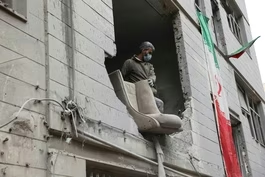
LEILA MOLANA-ALLEN: As bombs fall and streets burn, a country of 92 million people cut off from the world.
Each morning reveals shattered husks of residential buildings across Iran's densely populated capital, lifeless bodies pulled from the rubble.
A child cries for his mother buried beneath the debris that was their home.
Parents mourn the broken bodies of their children, young and old, voiceless as they contend with the communications blackout imposed by their own government.
But even as the regime appointed a new supreme leader after the killing of his father, they found a way to make their feelings known.
"Death to Mojtaba," they chanted from their balconies.
But the widespread anti-government protests some hoped for have not come.
In brief moments of connectivity, the "News Hour" spoke to Iranians inside the country, who told us their focus right now is survival.
We're keeping them anonymous to protect them from possible reprisals after the Islamic Republic sent messages warning people against speaking out.
We spoke to a young mother in Tehran with a 3-year-old son.
She's taped over her windows and piles cushions around her little boy as he sleeps, trying desperately to keep him safe.
WOMAN (through translator): I can't leave him alone in his room at night.
I go and sleep next to him because I keep thinking that, if something happens, I want to be beside him.
LEILA MOLANA-ALLEN: But she can't protect him from what he can see and hear.
With no access to a shelter, when the airstrikes come, they hide, cowering in their hallway.
WOMAN (through translator): I brought him some samosas to eat.
Suddenly, we heard the sound of fighter jets passing right above us.
It was very frightening.
Then we heard three explosions.
They were so intense that I thought the windows would shatter and be blown into the house.
Now, when I say to my little boy, "Come, I will give you samosas," he says, "I want them, but I don't want the thunder to come again and scare me."
LEILA MOLANA-ALLEN: Families say they stockpiled food, but, as U.S.-Israeli attacks increasingly target infrastructure, they're now terrified the electricity supply will be cut and they will lose what they have.
One man in Tehran told us the bombing is now so intense, it's impossible to hide from.
And everyone lives near the military and government buildings in the bomb sites.
Some people have tried to flee north away from the densely populated downtown, but the roads are packed and gas is scarce.
MAN (through translator): Being bombed is a truly terrifying sound.
No matter how much you feel you're getting used to it, every time you hear it, it haunts you.
LEILA MOLANA-ALLEN: He told us the people have endured so much already.
Now they're trapped between choosing death at the regime's hands or under foreign bombs.
They pray, if they must go through this war too, that it will at least lead to change.
MAN (through translator): What we want is for people to suffer less damage, endure less agony, and for fewer people to be killed.
Ultimately, we want the political outcome that follows to be in the interest of the people, not just for the benefit of politicians or Westerners.
LEILA MOLANA-ALLEN: A lucky few with foreign passports have decided to leave.
The U.N.
says around 1,300 people have left Iran each day via the Turkish border since the war began.
But even beyond Iran, the watchful eye of the Islamic Republic follows.
The "News Hour" spoke with several dissidents who recently escaped Iran.
We're keeping their location secret for their safety.
Shaheen fled last year, but continues to receive threats from regime operatives overseas.
Shortly after he left Iran, anonymous men showed up at his door.
SHAHEEN, Makeup Artist: Sometimes, they send e-mails, direct messages, phone calls, phone calls, and sometimes they do not threat you directly.
They threaten their family and their beloved ones.
They always find a way to silence the people.
It doesn't matter where you are.
LEILA MOLANA-ALLEN: Shaheen says the situation is worse than he's ever seen it, as people endure the bombing under a full Internet blackout.
SHAHEEN: There is no access to the outside world.
There is no freedom of speech.
It was never -- but now it's more restricted and more controlled, with more pressure, with more risk.
LEILA MOLANA-ALLEN: Mahzad is a journalist who fled after being harassed and interrogated for her political writing about Iran's 2022 Woman, Life, Freedom movement.
Now she's watching her country endure hell from afar.
She says it's impossible to overstate how badly traumatized Iran's people are, still reeling from thousands of young protesters being killed by internal security forces just weeks ago and now under daily bombardment.
MAHZAD, Journalist and Activist (through translator): That slaughter that took place in January was like a hell we can never get out of, and the impact it has left on the collective psyche of Iranians I think will last for years, centuries maybe.
LEILA MOLANA-ALLEN: She says it's an experience that unites the Iranian diaspora, deeply divided in other ways, the horror and guilt of watching their countrymen suffer.
MAHZAD (through translator): I couldn't separate myself for a moment from what was happening in Iran, emotionally, psychologically.
In the middle of the night, I would suddenly wake up to check my cell phone.
All I could do was stare at my phone and see how my people were rolling in blood.
I felt totally helpless because I knew how much they were suffering, and I couldn't do anything for them.
LEILA MOLANA-ALLEN: In spite of her anger at the government, Mahzad has determined that war will only lead to more pain and bloodshed.
MAHZAD (through translator): Until we have a practical solution for what comes next, taking out one regime or leader and replacing them with another will lead to the same dictatorship we have been suffering for at least a century.
This is a war in which I see no winner.
LEILA MOLANA-ALLEN: Mehran Kamrava is a professor of government and Iranian studies at Georgetown University in Doha.
An Iranian exile himself, Kamrava has traveled back to the country regularly over the past four decades.
I asked him why there's so little in the way of a defined political opposition inside the country.
MEHRAN KAMRAVA, Georgetown University Qatar: The Islamic Republic succeeded in eliminating any viable opposition.
From 1980 to about 1988, there was a reign of terror in Iran where, people were executed en masse.
Then we have mass repression in the form of people being thrown in jail or people being kicked out.
LEILA MOLANA-ALLEN: Kamrava says his research suggests that, after years of economic stagnation, corruption, repression and violent crackdowns, public support for the regime could have fallen as low as 10 percent.
But that group are ardent supporters, while the majority of the Iranian public has not united around who or what they want to replace it.
MEHRAN KAMRAVA: We do know that the Islamic Republic is not popular among 90 -- 80, 90 percent of Iranians, many of whom are willing to risk their lives to express that opposition, that disgust with the Islamic Republic.
LEILA MOLANA-ALLEN: And, right now, we have Donald Trump saying to the Iranian people, this is your opportunity to rise up and protest and get rid of this government.
Is that something that they are in a position to do while under bombardment?
MEHRAN KAMRAVA: Absolutely not.
Life in Iran now is a daily struggle for survival literally.
It's a struggle for life and death.
There is absolutely no appetite for protest.
Bombs raining from the sky is not help, does not bring democracy, doesn't bring regime change, doesn't bring relief.
It only brings misery and tragedy and death and destruction.
So there is a sense that yet again the United States betrayed Iran.
It betrayed the Iranian people when Donald Trump said help is on its way, and the only thing on its way are B-2 bombers.
LEILA MOLANA-ALLEN: A people attacked on all sides with just one short-term priority, living to see another day.
For the "PBS News Hour," I'm Leila Molana-Allen in Doha, Qatar.
GEOFF BENNETT: More than two weeks into the war with Iran, Muslim Americans are confronting a new surge of hateful rhetoric here at home, amplified online and echoed by Republican lawmakers.
Tennessee Congressman Andy Ogles posted that Muslims don't belong in American society.
Florida Congressman Randy Fine wrote this: "We need more Islamophobia, not less.
Fear of Islam is rational."
And Alabama Senator Tommy Tuberville paired images of 9/11 with New York City Mayor Zohran Mamdani, saying -- quote - - "The enemy is inside the gates."
Civil rights advocates and Democratic lawmakers have condemned the remarks as dangerous and openly bigoted.
We're joined now by Maya Berry, executive director of the Arab American institute.
Thank you for being with us.
MAYA BERRY, Executive Director, Arab American Institute: Thank you for having us, Geoff.
GEOFF BENNETT: When you hear and read some of the comments from Republican lawmakers right now, what stands out to you most?
MAYA BERRY: I mean, to be honest, the initial response is just how broken our democracy is.
I feel it in a very personal way in terms of the targeting in the American Muslim community like this, the scapegoating of a community like this.
But the fact that it's coming from elected officials who have American Muslim constituents who should understand with greater clarity how their rhetoric is perhaps different than mine or yours, and yet they feel very comfortable continuing to engage in this, stoking fear and putting communities and individuals at risk.
GEOFF BENNETT: Does the rhetoric we're hearing now, does this represent an escalation or is this part of a longer pattern in American politics?
MAYA BERRY: So I think that's a really important observation.
Communities being scapegoated at different times for different reasons is certainly a pattern in our country.
What's different here, and I would even suggest worse than what we saw post-9/11, is that after the terror attacks in 9/11 happened, you had elected officials, a president, who went to a mosque within a couple of days to get those attacks and said, do not target your fellow Americans.
This is not who we are.
This is not what we're going to do.
Now, obviously, there are policies that ensued that securitized a community, that treated it as a potential security threat moving forward and that really harmed the relationship between those individuals and their fellow countrypeople.
But what I would say is that, when the largest office of the land, the presidential bully pulpit, is being used to tell their fellow Americans, do not scapegoat those communities, that's very, very different than what we see today.
The single largest crime -- or hate crime data that we had that targeted both actually Arab-Americans and American Muslims came after 9/11.
The second largest numbers came after the 2015 and 2016 years, which is the beginning of President Trump's initial campaign and running for office.
So there is certainly, I think, a decision among some that this rhetoric is helpful.
It gives them viral moments.
It helps them raise money.
That, to me, is why I keep emphasizing that you should care about this because it is harmful to a community, but you should also care about this because I think it is indicative of how problematic and how fragile our democratic institutions are right now.
GEOFF BENNETT: And you have some defending their remarks by pointing to these recent attacks allegedly carried out by Muslim men, the car ramming at a Michigan synagogue, the shooter at Old Dominion University last week.
President Trump, who you mentioned, he was on Brian Kilmeade's FOX radio show last week.
Take a listen to what he said.
DONALD TRUMP, President of the United States: They're sick people.
And a lot of them were let in here.
They shouldn't have been let in.
Others are just bad.
They go bad, something wrong.
There's something wrong there.
Genetics are not exactly -- they're not exactly your genetic.
It's one of those problems.
GEOFF BENNETT: I want to ask you to respond to that.
And there can be legitimate concerns about how people become radicalized and then carry out acts of violence.
There's a separate question around how leaders address that without turning it into sweeping claims, derogatory claims about millions of Americans.
MAYA BERRY: Look, I'm not going to argue that someone who resorts to violence like we saw in the horrific attack in Michigan or the shooting in Virginia isn't perhaps sick in some way.
There's something wrong there, without a doubt.
The difference, though, is that no one would suggest that we engage in that kind of talk when we talked about the Sikh shooting, the temple shooting in Oak Creek.
No one said that when there was a shooting in South Carolina.
No one said that when we were talking about the devastating killing of congregants at the Tree of Life Synagogue or Charlottesville, Virginia, where Heather Heyer was killed, or the supermarket in El Paso.
There have been systematic ways in which our country has increasingly moved with some level of comfort with political violence that's really very alarming.
There were two assassination attempts on President Trump.
There was a legislator and her husband that -- killed in Minnesota.
The question is, why do we take those individual incidents and understand there to be a problem that our country has to address and not suggest that we develop a different relationships with white supremacists, for example, who've engaged with those and start saying that we need to -- what went wrong?
How do we take away their citizenship?
What's the denaturalization process?
None of that happens, except when it is looking at American Muslims and sometimes Arab Americans.
GEOFF BENNETT: Well, on that point, I want to ask you this, because in the past, party leaders have taken action against members of Congress for racist and extremist rhetoric.
That was the case back in 2019, when Speaker, then-Speaker Kevin McCarthy booted Steve King off of his committees for racist rhetoric.
Fast-forward to the present moment.
There doesn't appear to be that same level of accountability.
What's the impact of that?
MAYA BERRY: No, to the contrary, there's no censure.
There are no committees assignments being withdrawn.
In fact, in the case of Congressman Randy Fine, the day he actually said starve them all is the day that he was appointed to the House Foreign Affairs Committee.
And you have a situation where the House speaker, instead of saying this kind of rhetoric must stop, it's harmful to our fellow Americans and we ought not to engage in it, he said there's a legitimate fear about Sharia, demanding Sharia law in our country.
Sharia law is something, a concept within like a moral or religious code that applies to me personally.
It would never apply to you or anyone else if they weren't Muslim.
It dictates things like our prayer or our marriage processes or burials.
So this idea that we're going to take something like that and the speaker would suggest this is the reason why his members would get away with saying the kinds of things that they said is just intellectually dishonest and morally replicable.
GEOFF BENNETT: Beyond the rhetoric, are you seeing signs that these attitudes are influencing policy?
MAYA BERRY: Without a doubt.
There have been some pretty, pretty significant setbacks in terms of basic civil rights protections and First Amendment protection rights.
But I would focus more on -- at this point, frankly, I go back to Congress, because certainly I'm not suggesting the executive is working great.
But the issue with Congress is, it's not just that a member tweets something that's reprehensible.
Look at the remarks they're giving on the House floor.
Look at the questions and comments they make during congressional hearings.
It's not just about, like, they need to engage or behave in ways that are decent.
It's really about a structural problem within the body itself.
It's not passing budgets on time.
It's not passing laws.
There's no congressional oversight.
Our country just went to war without a war powers resolution.
But what do they find time to do?
They find time to sit and tell us that we need to fear our fellow Americans.
GEOFF BENNETT: Maya Berry, executive director of the Arab American Institute, thank you for your perspectives.
MAYA BERRY: Thank you.
AMNA NAWAZ: Primaries for the midterm elections are under way, while President Trump pushes for a sweeping voting bill.
For analysis of that and the politics of the war with Iran, we turn now to our Politics Monday duo.
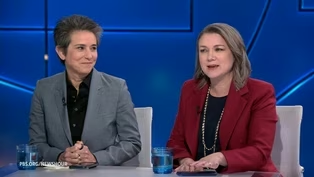
That is Amy Walter of the Cook Political Report with Amy Walter and Tamara Keith of NPR.
Good to see you both.
TAMARA KEITH, National Public Radio: Hello.
AMY WALTER, The Cook Political Report: Great to be here.
AMNA NAWAZ: All right let's start with this SAVE America Act, the Safeguard American Voter Eligibility Act.
This legislation, as you know, would require people to show proof of citizenship to register to vote in federal elections, also to show I.D.s when they're voting in person or by mail.
Tam, President Trump says it's his number one legislative priority.
Senate Republicans do not have the votes.
Why is it so important to the president?
And what are Republicans going to do?
TAMARA KEITH: President Trump has had a pretty single-minded focus on election laws.
Going back to even 2016 after he won, he said that there had been illegal votes and he would have won more, he would have won the popular vote if it hadn't been for all the illegal votes.
So this is a thing that he has been talking about as long as he has been on this stage.
But also this comes in a broader context, which is just at his State of the Union address for instance.
He said Democrats can't win unless they cheat as he was arguing for this law.
That certainly sounds like someone who is coming up with a message that he could use after the election results if Republicans don't hold the House or don't hold the Senate.
I did ask a White House official about this, and he insisted that, no, this isn't about that.
It's just that the president really cares about election security.
But the fact is, it doesn't have the votes to get through the Senate, and the president is staking a whole bunch of political capital on this.
He believes it's one of these 80/20 issues, that it's the thing that they can all run on.
I think there are a lot of people in Congress, Republicans in Congress, who would like to run on an economic message instead.
But that is being challenged in multiple different ways.
AMNA NAWAZ: We should point out it's not an 80/20 message.
Our latest poll actually shows some 59 percent of people say they're more concerned with making sure everyone who wants to vote can, less, about 41 percent, with stopping what would be called ineligible voters.
And, Amy, we should also point out that noncitizen voting is extremely rare, right?
AMY WALTER: Right.
It's -- absolutely.
Here's another thing that I think is problematic for Republicans who are on the ballot in 2026.
The more the president talks about the election potentially being rigged, or it's going to get stolen and Democrats are going to win anyway because they didn't pass the SAVE Act, the harder it is going to be for Republican voters to get motivated to show up and vote in the first place.
I mean, if you're telling your own voters over and over again, hey, this thing's rigged anyway, we're going to lose, what incentive do they have to show up.
This is especially problematic at this time, because Democrats already have an enthusiasm advantage.
If you look at the results of the special elections that have been held so far this year, Democrats are turning out at a much higher level than Republicans.
Same with the question on polls.
How enthusiastic are you to show up to vote?
Democrats are much more enthusiastic.
So while I think the president, I agree with Tam, I think is setting up the straw man for what happens if there's a bad election, he could blame it on this, we have already seen in previous elections, like in 2020, he went down to Georgia, was very frustrated with the results of that election, said it was rigged there.
In the run-off election that was held a month after the regular election in November, the two Republicans lost in those Senate races, in part because the president went down and said it's rigged.
AMNA NAWAZ: It's rigged, yes.
Well, meanwhile, midterm primary season is upon us.
Illinois is holding theirs tomorrow.
It's a very crowded Democratic primary to replace longtime Senator Dick Durbin.
And our latest poll has the generic ballot with a nine-point advantage for the Democrats at 53 to 44 percent.
Amy, let's start with you here.
What's at stake for the Democrats in these early primaries?
AMY WALTER: So Illinois is a little bit different because it's such a blue state.
So the winner is going to go on and most likely show up and be a senator in November.
What we are seeing in a lot of these Democratic primaries, Texas was one example of this, is really a fight between two theories of the case among Democrats.
One is, do you want somebody who's more of a compromiser, who's willing to maybe work across the aisle and potentially win over independent voters who aren't aligned with Democrats?
Or do you want somebody who is basically all in, who's not interested in compromise?
It's a zero sum game.
That is a choice that we're going to see in a number of primaries coming up, especially in places like Maine, Minnesota, Michigan.
AMNA NAWAZ: Tam, how are you looking at these?
TAMARA KEITH: Yes, so I would say that these primaries are not necessarily going to tell us everything about the future of the Democratic Party.
I do think that there's an interesting House race where there are some generational divides and some other issues that are playing out that could tell us a little something about what Democratic voters think about Democratic candidates.
But it is important to note that there are a lot of primaries in either very red states or very blue states where the primary is the election.
The primary voters are going to decide who represents that state or that district.
AMNA NAWAZ: Meanwhile, we know the war with Iran continues.
And, Tam, I want to start with you here, because, as it enters its third week, gas prices, which had been coming down early in President Trump's second term, continue to go up.
When does this start to become an issue for voters in the midterms?
TAMARA KEITH: It's an issue, that voters are not making their final decision on November right now, but it is absolutely an issue.
I'm talking to voters about this, and they're telling me that it's costing more to fill up and that they're frustrated and they're angry and that it happened, like, overnight.
And I think we talked about this last week also, but President Trump, by not really preparing the American public for this war, also didn't prepare the American public for the sacrifice.
And so he told Liz, he has told others that it's a small price to pay.
But for people who are living paycheck to paycheck, this is actually a big price to pay.
And this is an election that we know is going to hinge on affordability and the cost of living.
Every voter I talk to says the economy is the most important issue that will determine their vote.
And previously, when President Trump was asked about affordability, he pointed to cheap gas prices, literally hours before the war started.
He was pointing to low gas prices.
And now those prices aren't low.
They're up about 85 cents from last week.
AMY WALTER: And yet you're not really seeing much movement in the president's overall approval ratings.
He's not going up, he's not going down.
And that's because most voters are already so polarized.
It's hard to believe that anybody's going to move whether things go well or whether they don't.
The real question and what people keep watching for is whether there will be some really serious cracks within the Republican support for the president.
Right now, it's not there even among those -- there was an NBC poll out last week that showed, even among Republicans who said they disapproved of the way Trump's handling the issue of Iran, overall, they approve of the job he's doing as president.
So, there may be some cracks, but they're not doing much damage to the president standing right now.
TAMARA KEITH: His voters are giving him the benefit of the doubt.
AMY WALTER: That's right.
AMNA NAWAZ: Amy Walter, Tamara Keith, always good to start the week with you.
Thank you.
AMY WALTER: You're welcome.
TAMARA KEITH: You're welcome.
GEOFF BENNETT: Edgar Ramirez is an L.A.-based artist who transforms street signs inspired by the industrial landscape where he grew up.
He turns the signs into striking pieces of art that highlight the realities of his community.
Here's his Brief But Spectacular take.
EDGAR RAMIREZ, Artist: There's these predatory loan posters.
I noticed them in my drives throughout the neighborhoods of Los Angeles.
They're advertisements for fixing your credit or home loans.
And I started to collect these signs.
And I thought about who lives in these kind of communities, these underserved communities.
When I see signs of exploitation and people being taken advantage of, there's this urge to want to just yell out or rip something up.
And my space, my art allows me to do so without judgment.
So I would remove these signs and cut out the lettering and paint over them, as a house painter would.
I create stencils of them.
It makes me think about the history of what once was there.
And I think we tend to forget there's a sense of resilience, determination and perseverance.
And I find that akin to the people that live and thrive in these communities.
I grew up in Los Angeles, California, in a small town called Wilmington.
It's a neighborhood characterized by heavy industry, oil refineries, one of the world's busiest ports.
There's a lot of beauty to be found within this neighborhood, especially with the people.
Like my parents, immigrants, they came here in the '70s, predominantly Mexican-American.
From a really early age, I was really into impressionist art.
And that sort of led me to Monet and van Gogh, Turner, Constable.
It's something that found me.
I hope that, when people see my work, they get a great sense of where they're at.
I think about all these layers, all this noise that make up the city.
And, essentially, that's the language that I'm doing when I'm making these paintings.
It's sort of mimicking how I see things in the city working.
My community and the people that I have shown this to have responded in a way where they're acknowledging it.
I hope my art helps people question what's around them.
My name is Edgar Ramirez, and this is my Brief But Spectacular take on the science of exploitation.
GEOFF BENNETT: And you can watch more Brief But Spectacular videos online at PBS.org/NewsHour/Brief.
And that's the "News Hour" for tonight.
I'm Geoff Bennett.
AMNA NAWAZ: And I'm Amna Nawaz.
On behalf of the entire "News Hour" team, thank you for joining us.
 New
NewAnti-Islamic rhetoric from GOP politicians sparks concerns
Video has Closed Captions
Clip: 3/16/2026 | 8m 5s | Anti-Islamic rhetoric from GOP politicians sparks concerns over religious hatred (8m 5s)
 New
NewA Brief But Spectacular take on the signs of exploitation
Video has Closed Captions
Clip: 3/16/2026 | 2m 29s | A Brief But Spectacular take on the signs of exploitation (2m 29s)
 New
NewIranians share messages describing life in the midst of war
Video has Closed Captions
Clip: 3/16/2026 | 9m 2s | Iranians share messages describing daily life under the shadow of war (9m 2s)
 New
NewMideast experts on Trump’s push to reopen Strait of Hormuz
Video has Closed Captions
Clip: 3/16/2026 | 7m 44s | Middle East experts discuss Trump’s pressure on NATO to reopen Strait of Hormuz (7m 44s)
 New
NewNews Wrap: Chaotic weather system delays U.S. travelers
Video has Closed Captions
Clip: 3/16/2026 | 8m 22s | News Wrap: Chaotic weather system delays U.S. travelers (8m 22s)
 New
NewTamara Keith and Amy Walter on Trump's push for the SAVE Act
Video has Closed Captions
Clip: 3/16/2026 | 8m 7s | Tamara Keith and Amy Walter on the impact of Trump's push for the SAVE Act (8m 7s)
 New
NewTrump demands NATO allies help reopen Strait of Hormuz
Video has Closed Captions
Clip: 3/16/2026 | 4m 43s | As Israel launches Lebanon ground operation, Trump asks allies to help reopen oil route (4m 43s)
 New
NewWhat Trump said about oil prices in call with PBS News
Video has Closed Captions
Clip: 3/16/2026 | 2m 59s | What Trump said about Iran's infrastructure and oil prices in call with PBS News (2m 59s)
Providing Support for PBS.org
Learn Moreabout PBS online sponsorship
- News and Public Affairs

FRONTLINE is investigative journalism that questions, explains and changes our world.

- News and Public Affairs

Amanpour and Company features conversations with leaders and decision makers.











Support for PBS provided by:
Major corporate funding for the PBS News Hour is provided by BDO, BNSF, Consumer Cellular, American Cruise Lines, and Raymond James. Funding for the PBS NewsHour Weekend is provided by...