Here and Now
Here & Now for March 13, 2026
Season 2400 Episode 2435 | 26m 47sVideo has Closed Captions
Watch the entire episode of Here & Now for March 13.
Watch the entire episode of Here & Now for March 13.
Problems playing video? | Closed Captioning Feedback
Problems playing video? | Closed Captioning Feedback
Here and Now is a local public television program presented by PBS Wisconsin
Here and Now
Here & Now for March 13, 2026
Season 2400 Episode 2435 | 26m 47sVideo has Closed Captions
Watch the entire episode of Here & Now for March 13.
Problems playing video? | Closed Captioning Feedback
How to Watch Here and Now
Here and Now is available to stream on pbs.org and the free PBS App, available on iPhone, Apple TV, Android TV, Android smartphones, Amazon Fire TV, Amazon Fire Tablet, Roku, Samsung Smart TV, and Vizio.
Providing Support for PBS.org
Learn Moreabout PBS online sponsorshipPBS Wisconsin Original production.
>> I believe that we need to be clear eyed about why the price of gas is going up.
>> Global economic impacts and the price of oil add to the fallout of a war with Iran.
And Iranians voiced the personal toll of the ongoing conflict.
[MUSIC] Tonight on "Here& Now" we hear from Iranians in Wisconsin watching the war unfold in their homeland, an important bridge connecting Superior and Duluth awaits federal funding.
We hear from candidates for Wisconsin Supreme Court and governor, and an Oneida program maintains traditional tribal foods.
It's "Here& Now" for March 13th.
[MUSIC] >> Funding for here and Now is provided by the Focus Fund for Journalism and Friends of PBS Wisconsin.
>> Watching and living the war from afar.
That's what Iranians in Wisconsin face as they worry and wonder about family and friends.
They're cut off from communication "Here& Now".
Reporter Steven Potter spoke with two Iranian people in Milwaukee about being so disconnected from loved ones during these times, and the hopes they have for their homeland after the war.
>> Watching the war in Iran unfold from thousands of miles away is causing a lot of worry for Wisconsin residents like Zahra Fakhri and Ali Soltani.
Communication with loved ones still in Iran is infrequent at best.
>> It's because of the blackout.
There's no way to call them.
So they're calling us directly by the phone lines.
And the quality of the call is terrible.
What they say is always that we're we are okay.
Everything is fine.
>> Have you been in contact with friends and family that you have in Iran?
>> Yes.
Internet is cut off, right?
So my sister just yesterday through landline had called me.
They all have moved to smaller cities, so they're not in Tehran anymore, even in the small cities, a couple places where these are the garrisons and security forces, places that have been hit.
She knew about those.
But Tehran is really a lot of people here, a lot of loud noises, the bombing and scare some people.
Of course.
>> Fakhri and Soltani have different feelings about the United States and Israel beginning the war in Iran and removing the country's supreme leader from power.
>> It was the last option for us.
At first, we were so happy because of the intervention that we were waiting for.
After that, we got really happy and thrilled because of the death of the Khomeini.
But we all knew that it's not just one person, it's a systematic.
We cannot say that and topple that government down just by killing one person.
>> We have always opposed foreign war.
It's a very brutal regime.
So some people, because they were fed up, they they said, oh, United States come and attack that kind of mentality.
But foreign interference will never end up well in the long run.
>> But Fakhri and Soltani do agree that it should be the Iranian people who decide who leads their homeland, and it should not be the leaders of other countries who choose Iran's next government, who should lead Iran.
>> Whoever.
Iranian people inside Iran and Iranian people outside of Iran agreeing with.
>> We want the US, the international community to let the Iranians.
After 120 years of fighting for freedom, we don't want to go back to another dictatorship.
It doesn't matter how you sugarcoat it.
It's a dictatorship.
We don't want to go to one man rule.
We don't want no clergy.
We don't want no Shah.
We want a non-nuclear, secular, democratic republic based on rule of law, that if you don't like somebody, you can vote them out, right?
Just like us, just like France, just like many democratic countries.
>> What resolution are you hoping for in the end?
>> Getting rid of Islamic regime, Iranian people doing their job to make the country free and having a secular government and better place and showing the world what is real Iran and what is real Iranian people, and how it could be a better world with peaceful country in the Middle East.
That's what we are looking for.
>> We want the US and every other country to recognize our right to choose our own form of government.
That is what's dear to us.
And that's what actually, in the long run, is for the benefit of Iran and the international community.
>> Reporting from Milwaukee.
I'm Steven Potter for "Here& Now".
>> An iconic connector between superior, Wisconsin and Duluth, Minnesota is set to close early next year.
The Blatnik Bridge opened in 1961, and now more than 65 years later, is scheduled for reconstruction.
According to the governor's office, more than 33,000 vehicles cross every day and more than 265,000 transport trucks traverse the bridge each year.
In 2024, former President Joe Biden visited superior to draw attention to funding just over $1 billion for the project.
As part of the bipartisan infrastructure law.
But now, U.S.
senators in two states and Wisconsin Governor Tony Evers, have written letters to the U.S.
Department of Transportation to release that funding so the project can proceed.
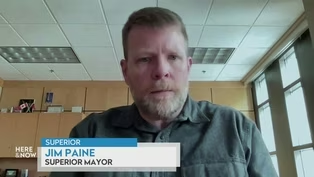
Superior Merrick Jim Paine is part of the chorus calling for the grant money to be released, and is heading to Washington to personally appeal to D.O.T.
and Secretary Sean Duffy.
So the project can get going.
He joins us from Superior and Mayor.
Thanks for being here.
>> Yeah.
Of course.
Thanks for having me.
>> So how critical is it to get this funding released sooner rather than later?
>> Well, at first will be okay because the there are some delays built into the project.
The problem is this the later we start, the later we finish and the.
The effect of the closure of the bridge is significant.
And that's what we're preparing for.
And any extension of that closure is problematic for the economy and quality of life of both superior and neighboring Duluth.
So the later it starts, the later it finishes.
>> What has the U.S.
Dot told you about when that might happen?
>> Nothing.
And until now, we had reasonable assurances that this was going to happen.
There was a lot of uncertainty at the start of this presidential administration, but that was supposed to have been resolved that that this project was going forward.
So this is a very frustrating delay.
>> And Transportation Secretary Sean Duffy, of course, knows the region, having represented it and and knows the importance of this bridge.
>> I would hope so.
I would think so.
This is a vital connector, not just for the cities of Superior and Duluth or the states of Wisconsin and Minnesota.
This is an international connector.
The age of the bridge already limits the freight loads.
There's almost no freight that moves over it, but it's going to be a vital connector for international shipping between Michigan, Canada, northern Minnesota, really the entire continent.
It's a very vital connection.
The Secretary of Transportation should understand that and recognize this.
Look, one of the most important things to note here, there is no question about the fact that this bridge is closing.
It is at the end of its life.
It is going to close.
The only question in front of us is whether it's going to reopen with a new bridge and when.
>> So when the bridge closes, how will people get across?
>> There's another bridge.
The Bong Bridge is another major connector which can handle the load, but it's going to create significant bottlenecks.
If you look at even a map of Wisconsin, you can see superior is sitting as a nice little hat there at the very northwest corner, and it already creates some backlogs.
When enough freight is moving through the city, that will become demonstrably worse during bridge closure.
So the longer that lasts, the the greater the impacts on quality of life and commerce.
>> Meanwhile, your city has already expended money toward the eventual replacement of the bridge.
What is the preparation and that expenditure?
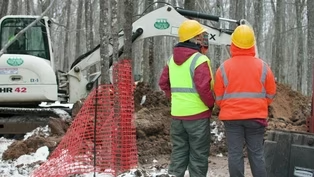
>> There's been millions and millions of dollars in prep.
A lot of it has been relocation of whole businesses, some of them as much as 100 years old that were operating at the foot of that bridge.
We cleared it all out and look, we did our part.
We spent a significant amount of public, local money, city of superior money to help relocate businesses, to improve transportation networks, to actually rebuild streets, improve them, to mitigate traffic, to to prepare for faster and more efficient emergency response during bridge closure.
We have done our part.
The state of Wisconsin, the state of Minnesota have done their part.
Everything is ready.
We're waiting for the federal government to to live up to its end of the deal.
>> And so the new bridge is supposed to be up and operating by, what, 2031?
>> Hope so this is a transportation project, and any transportation project involves delays.
So an unforeseen delay like this, a what seems to be a political delay only adds to the uncertainty and complexity of an already uncertain and complex project.
>> So Republican lawmakers say the funding will be released and it's not in jeopardy.
You just used the word political.
What do you what do you think the holdup is?
>> I honestly don't know.
I've worked with many different state and federal administrations at this administration.
And while there have been there's been plenty of disagreement on priorities.
I've never dealt with this level of chaos.
I don't know what the holdup is.
I appreciate that lawmakers are saying that it will be released.
Well, then release it, sign the document, show us that we have the money so planning and preparation can resume.
I don't know if if it's so guaranteed.
Let's hear that from the Secretary of Administration.
Words do not build bridges.
Actions do.
>> Mayor Jim Paine, thanks very much.
>> Thank you.
>> In the last few weeks, President Donald Trump has continued to dredge up conspiracy theories about his election loss to Joe Biden in 2020.
Election controversies are often settled in court.
The Wisconsin Supreme Court election is less than a month away, pitting conservative candidate Judge Maria Lazar against Liberal candidate Judge Chris Taylor.
Here and now.
Senior political reporter Zach Schultz interviewed the candidates about an important Supreme Court decision from the 2020 election to ask them how they would have ruled.
>> We won.
Let's go.
>> In the days after Joe Biden won Wisconsin and the race for president in 2020, Donald Trump and his supporters immediately began spreading election conspiracies among his efforts to overturn the election, Trump's campaign sued in Wisconsin, attempting to throw out 220,000 ballots in Dane and Milwaukee counties, the two largest Democratic areas of the state.
The case reached the Wisconsin Supreme Court as Trump v Biden and with conservatives in control of the court, it was Justice Bryan Hagedorn who sided with the three liberal justices to deny Trump's request and refuse to take the case, saying the campaign did not have standing to sue.
The three other conservatives did not say whether they would have sided with Trump and thrown out the ballots, but they would have taken the case.
We asked the candidates in this election how they would have ruled if they'd been on the court.
>> I would have rejected that effort.
Again, that stands in contrast with my opponent.
My opponent has been supported in the past in her Court of Appeals race by the same individuals that led the charge in trying to overturn our 2020 election.
I think that was the right decision.
That was, again, a one only a one vote decision, which is alarming because if that case had been successful, hundreds of thousands of votes in the state of Wisconsin would have been thrown out.
And that's alarming to me.
>> Judge Lazar, like the conservatives who dissented in that case, focused on whether Trump had standing to file suit.
>> This is sort of an area that's really deeply in flux with our state Supreme Court.
They have issued several opinions that have gone around the edges of it, and so I'm not going to comment any further on where they would go, because I honestly believe that standing is going to come back up in our next term.
So when I'm on this court, I don't want to have someone say, you said in an interview, so now you can't rule in this case.
>> As far as whether someone's going to say, well, you didn't answer the question.
Trump v Biden, would you have overturned all those votes?
Can you give me a reaction to that?
>> I have answered the question, but with respect to overturning votes, I strongly believe that every vote should be counted.
So every legal valid vote should be counted.
So I wouldn't comment, and I don't actually know the parameters of how they were going to try to disenfranchize or not disenfranchize voters.
So I really don't have any further thing that I can say about that case.
>> Reporting from Madison.
I'm Zach Schulze for "Here& Now".
>> On the current Supreme Court.
Former Chief Justice Annette Ziegler announced this week she will not seek reelection, opening another seat on the High Court for the spring election of 2027.
Last week, we reported on exploratory mining happening again in northern Wisconsin.
The company, Greenlight Metals is looking for gold and copper and other minerals in Taylor County.
After the repeal in 2017 of Wisconsin's old mining law, Wisconsin's prove it.
First law, otherwise known as the mining moratorium, was passed in 1997 and required mining companies to demonstrate where anyone had safely operated a metallic sulfide mine for at least ten years, and also where a mine had been safely closed for ten years.
The mining company and environmental groups disagree on whether that standard could be proven if it was still in place today.
In 2017, Republicans in the legislature, led by then state Senator Tom Tiffany, eliminated those provisions as part of our continuing series examining the biggest issues in the race for governor "Here& Now".
Senior political reporter Zac Schultz asked the candidates about mining.
>> Roughly Greenlight Metals the Wisconsin chapter of the Sierra Club.
And the friends of the yellow River are well aware.
Control of the legislature and governor's office could flip this fall, meaning the regulations governing mining in Wisconsin could be up for debate.
We asked the leading candidates for governor what they thought about mining in Wisconsin, and if they would seek to change the current regulations.
>> You know, I think that we've seen decades of us ignoring people's rights when it comes to some of that land, whether it's our tribal nations in the state and also ignoring the economic, I'm sorry, the environmental impact on some of our areas.
Natural resources in Wisconsin are the basis of our economy.
We have to protect them, while at the same time we have to use them responsibly.
We have to make sure that our mining laws are in tune with current mindset around how we protect people's rights in in the land and protecting the environment with making sure that we keep using the resources in a responsible way.
>> There has to be community buy in and community input for people who have made their homes in a, in an area, you know, 20, 30 years passed down generation to generation.
I think that folks should have some input on what happens in their backyard.
And all I'm saying is have the conversation.
That's the important part.
When we have those those times where we're mining may come up and in a part of the state.
Yeah, well, talk to the community.
Like let's talk it out because the only thing that happens is more resentment.
If that conversation doesn't happen.
>> I am staunchly opposed to the type of mining as well as drilling.
When it comes to line five.
I have been vocal about my opposition there.
I think the dangers that this is presenting to communities who have already seen services be cut, their schools, you know, closing.
I think that having this type of, you know, this type of harmful.
These types of harmful groups coming in to impact local environments and the quality of life.
It's, it's really unfortunate.
And I think it's very important that we look at how to hold these corporations accountable.
>> What I think we need to do is to make sure we have a really good environmental assessment for permitting for those mines, and to make sure that we are talking with the local communities.
If tribal nations are involved, we are having those open conversations with them and making sure that we're not having the environmental impact that would be negative for Wisconsin.
>> I think one of the most important things that we have in Wisconsin, a differentiator that we have in Wisconsin versus other places around the country, is the natural beauty, the ability that we have to go out and enjoy Wisconsin.
And that's not a partizan issue.
That's not an ideological issue.
That's a a vision that we share for the state.
And so as we think about anything that would do any potential harm to the state of Wisconsin, I think we need to be very cautious about that.
I think there are issues around economic development that I think we need to try to find that right balance.
And if it's time to revisit that issue or it's time to have that conversation, I'd be all for it.
>> I thought we did a good job of writing the last mining bill for two reasons.
One is we made sure that we had the toughest mining law in the United States so that we are going to protect the environment.
We also provided for local control.
I think it's really important for locals to be able to have input in regards to these projects.
But this is something I mean, we've got a long, great history.
I mean, we have a miner on our flag, right?
And we have a long, proud history of mining here in in Wisconsin.
>> Well, it's about working with the local municipalities, working stakeholders that are on the ground and making sure that the work group that we can put together are giving us the best information possible to make the best decisions.
That's going to have a huge impact that can have a huge impact on the environment, as well as a new industry here in the state of Wisconsin.
And so you have to take that on a case by case basis and really working with all the stakeholders to make sure that we're making the best decision possible.
>> I think the current law has worked well for us.
I want to see mining companies prove first before they open up a hillside and pollute our water, that they're going to be able to extract things in a safe way that is consistent with our natural resources management and our environmental goals.
>> Reporting from Madison.
I'm Zach Schultz for "Here& Now".
>> To combat health disparities on the Oneida reservation.
Ukwakhwa or our foods is using a $250,000 grant to provide culinary knowledge and ancestral education to the Oneida tribal community "Here& Now".
Reporter Erica Ayisi traveled to De Pere to learn more about the.
From Seed to Table program.
This report is in partnership with Icty, formerly Indian Country Today.
>> Eldon Powless is an Oneida chef.
He's making lunch at Ukwakhwa or our Foods kitchen on the Oneida Reservation near green Bay.
>> Here I get to just do what I want.
They're just like, as long as it's.
As long as it tastes as good and it's nutritious.
Go ahead.
Comfort Bowl is an indigenous take on southern comfort food.
>> I wanted to do like a little twist on that and use wild rice and use the beans that we have and whatever we have available.
>> Local Ukwakhwa is in a restaurant, but Powless is their guest chef for this week's meal.
He says he uses some heirloom indigenous foods that are harvested on their farm.
The Oneida way.
>> I try to like, incorporate whatever we can get locally.
>> His recipe of diced celery, onions, carrots and locally sourced wild rice are added to a butter cream sauce with roasted corn.
Black beans.
Simmer in braised smoked ham hocks on the side.
>> Larsson.
Stieg.
Yeah.
>> Stephen Webster is director of farm and culinary operations at Ukwakhwa.
He says they're from sea to table grants with the Wisconsin Partnership Program subsidizes sales of hot lunches made by indigenous chefs to restore wellness to their diets.
>> They get a stipend.
They cook about 80 to 100 meals for the community.
The community then puts in orders how many we want, and then we pretty much disburse those meals throughout the community.
>> Webster says their grant program offers community members meals rooted in ancestral knowledge for modern living, integrating traditional ingredients like corn and beans with contemporary cuisine.
>> The goal of this was to try to expand people's palates.
>> The grant also subsidizes hands on meal preparation workshops using products harvested on the reservation.
>> We've had people make maple seed cookies, which blows my mind sometimes where I was like, it was, there was no gluten in it.
>> Webster says.
In this first year, the program is meeting its goals.
>> Like we did 1393 meals just through the Hot Meal Noon program.
And then we did another 80 some meals through the the meal prep class I talked about.
>> Webster says meals like the Northern Comfort Bowl would cost about $30 each in local restaurants, but Ukwakhwa is able to offer it here for $13 to the Oneida community due to the reduced pricing by the grant.
Webster says he hopes to continue the same pricing when funding ends.
>> But now I feel like we're much stronger from a logistics standpoint to take on this stuff in the future.
programs help the Oneida community reconnect to their indigenous foodways from a time when their ancestors were relocated from New York to Wisconsin in the early 1800s.
>> When they came here again, it was they were following Christian missionaries, but they were still people who practice our our traditions, our language and all that other stuff.
And a lot of those seeds came with them as well.
about indigenous cultivation?
most people are aware of is companion planting.
The three Sisters style of planting.
>> He says.
Maintaining oneida's agricultural methods of planting varieties of corn, beans and seeds next to each other is a balancing act of traditional and modern farming.
>> For 2 or 3 people like me and my wife to do it, we have to use the tractor, we have to do stuff, but we still make it a point to hand plant and hand Weid and so forth to keep those traditions alive.
>> Twice a month, the Ukwakhwa team delivers their culturally relevant meals to seven different drop off sites along the Oneida Tribal Department's route.
Webster Ana Ukwakhwa staff and volunteers packed up his truck with dozens of hot and ready, preordered meals prepared by that week's chef.
>> Hello there.
You get a bite one.
All right.
>> Toni House picked up her three meals at the Ukwakhwa farm, reflecting on her childhood memories of food insecurity from colonization.
>> I remember what it was like to be hungry as a child, you know?
And I remember thinking, how come people didn't hand me good foods?
>> She says the program will help younger children have an appetite and desire for healthy indigenous meals.
>> Nutrition right here impacts three generations automatically.
Scientifically.
We know that.
Now.
>> Back in the Ukwakhwa kitchen, Powless says, traditional indigenous ingredients can be cooked with love and risk while exploring new recipes.
>> You don't have to be super traditional and make it a certain way you can incorporate it however you would like.
>> Webster says.
From seed to table incorporates the past.
>> Make sure that we kind of like go back as much as we can.
>> For a healthier diet in the future.
>> To what maybe our ancestors were eating to help combat some of that and address some of that.
>> In De Pere.
I'm Eric Ayisi for “Here& Now” and ICT.
>> For more on this and other issues facing Wisconsin, visit our website at PBS Wisconsin and then click on the news tab.
That's our program for tonight.
I'm Frederica Freyberg.
Have a good weekend.
[MUSIC] >> Funding for Here and now is provided by the fund for Journalism and Friends of PBS Wisconsin.
 New
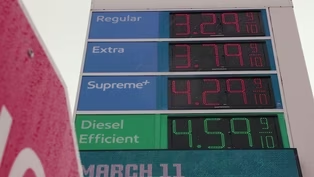
NewHere & Now opening for March 13, 2026
Video has Closed Captions
Clip: S2400 Ep2435 | 1m 7s | The introduction to the March 13, 2026 episode of Here & Now. (1m 7s)
 New
NewHow Ukwakhwa's Seed-to-Table Effort Celebrates Native Food
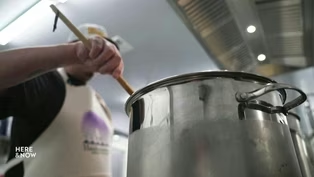
Video has Closed Captions
Clip: S2400 Ep2435 | 5m 47s | Ukwakhwa uses Indigenous foods to support local communities in the Oneida Nation. (5m 47s)
 New
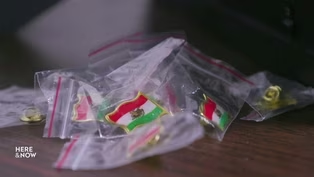
NewIranians in Wisconsin Share Worries on the Middle East War
Video has Closed Captions
Clip: S2400 Ep2435 | 4m 18s | Iranians living in Wisconsin share their perspectives as U.S. airstrikes continue. (4m 18s)
 New
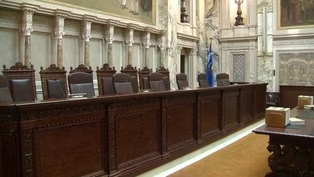
NewMaria Lazar, Chris Taylor on Wisconsin's 2020 Vote Lawsuit
Video has Closed Captions
Clip: S2400 Ep2435 | 3m 20s | Maria Lazar and Chris Taylor on the 4-3 decision to reject "Trump v. Biden" in 2020. (3m 20s)
 New
NewMayor Jim Paine on Funds for the Blatnik Bridge in Superior
Video has Closed Captions
Clip: S2400 Ep2435 | 5m 52s | Jim Pain on more than $1 billion in funds for reconstruction of the Blatnik Bridge. (5m 52s)
 New
NewWhat Wisconsin's 2026 Governor Candidates Say About Mining
Video has Closed Captions
Clip: S2400 Ep2435 | 5m 50s | Candidates in the 2026 race for governor on state laws that regulate mining. (5m 50s)
Providing Support for PBS.org
Learn Moreabout PBS online sponsorship
- News and Public Affairs

Top journalists deliver compelling original analysis of the hour's headlines.

- News and Public Affairs

FRONTLINE is investigative journalism that questions, explains and changes our world.











Support for PBS provided by:
Here and Now is a local public television program presented by PBS Wisconsin